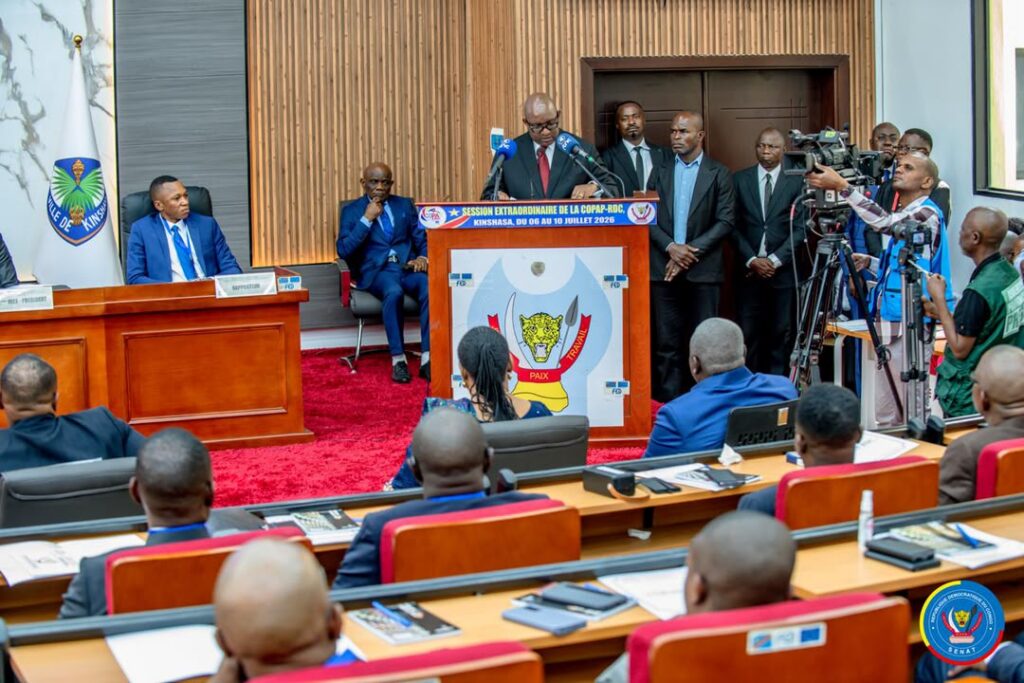
Kinshasa, July 6, 2026 (TOP243NEWS) – Opening the third edition of the Conference of Presidents of Provincial Assemblies (COPAP 2026), Senate President Jean-Michel Sama Lukonde placed decentralization at the center of the Democratic Republic of the Congo’s institutional agenda. His address comes at a time when the country’s provinces continue to grapple with recurring political tensions, budgetary constraints, and persistent insecurity in the eastern part of the country.
Established to strengthen dialogue among provincial institutions, COPAP has become one of the country’s leading platforms for consultation on territorial governance. This year’s conference takes place as several provinces continue to experience institutional disputes between provincial assemblies and provincial governments, slowing public administration and delaying the implementation of development policies.
Against this backdrop, Jean-Michel Sama Lukonde reaffirmed the Senate’s constitutional role as the institution representing the provinces, pledging to serve as a bridge between provincial authorities and the central government.
« The Senate, as the representative of the provinces, will always stand by your side, » he said, promising to present the conference’s recommendations to the Executive so they would lead to concrete reforms rather than remain merely political resolutions.
Decentralization: An Unfinished Reform
Nearly two decades after the 2006 Constitution established decentralization as a cornerstone of the Congolese state, its implementation continues to face significant obstacles. Delays in the effective transfer of powers, insufficient provincial financing, weaknesses in local governance, and strained relations between provincial executives and legislative assemblies continue to fuel institutional deadlock.
Against this background, COPAP 2026 is structured around four main priorities: assessing the state of governance across the country’s 26 provinces, strengthening mechanisms for preventing institutional crises, harmonizing the positions of provincial assemblies in defending the interests of decentralized entities, and enhancing the governance and parliamentary oversight capacities of provincial lawmakers.
Beyond institutional issues, the conference also aims to improve accountability at the provincial level and bring public governance closer to citizens.
Governance Under the Pressure of Multiple Crises
The conference opens amid an especially challenging national environment. In eastern Democratic Republic of the Congo, violence attributed to the AFC/M23 continues to undermine national stability, while the resurgence of Ebola in several provinces has once again exposed the fragility of the country’s public health system.
These security and health challenges compound economic constraints that limit the operational capacity of provincial administrations while increasing public expectations for effective governance.
In this context, the Senate President stressed that the upper house remains fully engaged in major national issues, including constitutional reforms and discussions on the legal framework governing referendums. He argued that strengthening provincial institutions is a prerequisite for more efficient and responsive governance.
A Test of the Country’s Decentralization Agenda
The outcomes of COPAP 2026 will be closely watched as a measure of the Congolese institutions’ ability to revive the decentralization process envisioned by the Constitution and supported by President Félix Tshisekedi.
Beyond political commitments, the real challenge will be translating the conference’s recommendations into operational reforms capable of improving local governance, preventing political crises in the provinces, and strengthening coordination between different levels of government.
For many observers, the success of COPAP 2026 could send a strong signal of the Congolese institutions’ determination to consolidate decentralization as a lasting driver of democratic governance and national development.
By Mike Pakoto.